
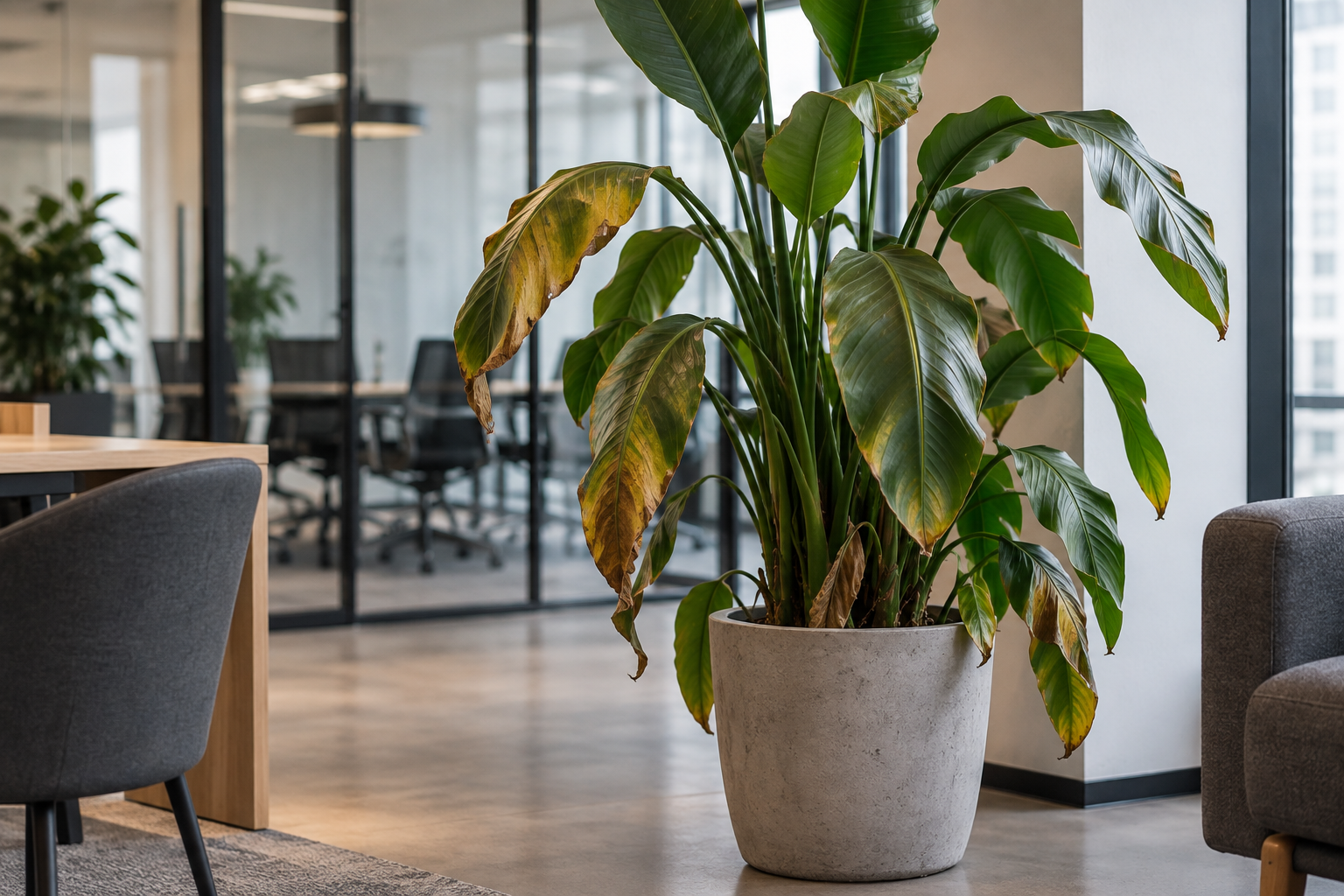
A struggling office plant can have more than one contributing cause, which is why it helps to work through a sequence of checks rather than look for a single explanation. Start with the root zone and the light. Then find out how consistently the plant has actually been cared for. If those three don't account for the decline, the next layer to investigate is the environment around the plant: airflow and temperature, pests, and anything that's changed in the space itself.
Overwatering versus underwatering, and how to tell them apart
Overwatering can show up as yellowing leaves, soft stems and wilting, which is why the instinct is sometimes to add even more water. Prolonged saturation reduces the oxygen available to the roots, and can eventually contribute to root damage or rot.
Many decorative office planters are used without conventional drainage because water escaping onto a lobby floor, desk or finished surface isn't practical. Every watering adds to standing water at the bottom unless someone checks for it. For many common office plants, snake plant, ZZ plant, pothos and similar, letting the top inch or two of soil dry before watering again is a reasonable starting point; succulents need it drier still, and moisture-loving species need more consistent dampness. Without drainage, the right amount depends on the plant, its root-ball size and the container's volume: check moisture a few inches below the surface rather than watering to a fixed amount, and check the base for pooling afterward.
Underwatering looks different: soil pulling away from the sides of the container, leaf edges going crispy and brittle rather than soft, foliage going limp between waterings, a root ball drying out faster than its size would suggest.
The two overlap enough that leaf appearance alone isn't a reliable diagnosis. A wilting leaf can mean dry roots, or damaged roots that can't take up water even though the soil is wet, which looks similar from a distance. The more reliable check is the soil and root zone itself: how it feels a few inches down, whether the pot is lighter or heavier than expected, and whether there's a sour or musty smell near the base, which usually means standing water and rot rather than dryness.
Then check whether the light is actually usable
Check how far a plant actually sits from usable light, not how bright the room looks overall. In open-plan offices with a lot of glass, light intensity can fall off sharply moving away from the windows: a plant against an interior wall, in a hallway, or lit only by fluorescent tubes can be getting a fraction of what it needs, even in a room that reads as well-lit to someone walking through it.
This layout shows up in Sorrento Valley and UTC especially, where reception areas often get daylight while the rest of an open floor runs on ceiling light alone.
Some species tolerate low light better than others: snake plants, ZZ plants and pothos hold up in conditions that would stall most other plants. Others, especially flowering plants that need more direct light than an interior office provides, are a mismatch for the space regardless of care. A plant stretching toward the nearest window, dropping leaves from the bottom up, or simply not growing is worth checking for a location problem before assuming it's the plant or the person watering it. Matching a plant's light tolerance to what a room actually provides, before buying it, is covered in more depth in our guide to choosing indoor plants.
Why maintenance ownership matters
In an office, plant care can easily become everyone's responsibility and therefore no one's responsibility: watering isn't formally anyone's job, so it's whoever remembers, whenever they remember. That gap, not one dramatic mistake, is how a small, fixable problem gets left long enough to become a dead plant: a little too dry, overcorrected with too much water, then not checked again for a couple of weeks over a busy stretch.
A scheduled maintenance contract closes that gap structurally instead of relying on someone to remember. Visit frequency is set during a walkthrough, weekly for high-traffic spaces like lobbies and showrooms, bi-weekly for most offices, and each visit covers the same scope:
- Watering and moisture management, checked and adjusted per plant and container
- Cleaning and dusting
- Pruning and trimming
- Pest and disease monitoring
- Planter and container upkeep
- Seasonal flower rotations, where applicable
Water, usable light and consistent care are useful first checks. When a plant is still struggling after all three, the next things worth ruling out are less about the plant and more about what's happening in the room around it.
When water and light don't explain it, check airflow and temperature
A plant can be watered correctly and sitting in a reasonably bright spot and still decline because of what's moving through the air around it. Direct conditioned airflow can dry foliage and the root zone unevenly, especially when a plant sits beside a supply vent or near an entrance with repeated drafts.
Also worth checking: whether the space cycles noticeably between hot and cold, for example a building that runs AC hard during business hours and drifts warmer or colder overnight and on weekends. If damage is concentrated on the side of the plant facing a vent or a draft, airflow is worth investigating rather than assuming it's a watering or light problem.
Check for pests before assuming it's just the environment
When watering and light both check out and a plant is still declining, pests are worth ruling out. A pest problem can go unnoticed longer on an office plant simply because fewer people are looking closely at it day to day, which gives it more time to establish before anyone notices.
The check doesn't require expertise: look at the undersides of leaves and along stems and nodes, not just the top of the foliage where a problem is easiest to spot. Sticky residue, fine webbing, cottony clusters or fixed bumps along stems and leaf joints can point to common indoor-plant pests such as spider mites, mealybugs or scale. This is a recognition step, not a treatment plan: the goal is catching something early enough that it stays small instead of spreading through the rest of the planting.
The plant didn't change. The office did.
Offices aren't static the way a plant's spot in someone's living room usually is. Reconfigurations, seasonal light shifts and small adjustments by cleaning or facilities staff are easy to overlook, since nobody thinks to connect them to a plant that's been fine for months.
Changes worth asking about: blinds that used to stay open now stay closed, usually to cut glare on monitors; a desk or partition moved during a reconfiguration that ended up between the plant and its light source; a planter shifted a few feet by a cleaning crew and never moved back; an HVAC vent or schedule adjustment; or simply the season changing, since the usable daylight through the same window in December isn't what comes through it in June. None of these show up as an obvious event. When a plant that was fine for months suddenly isn't, one of these changes is worth checking for, even when the plant itself never changed.
What to check first, by symptom
The same symptom can have more than one cause. Use the cards below to decide what to inspect next, not to diagnose the plant by sight alone.
Yellowing leaves
Check: soil moisture below the surface
May indicate prolonged moisture or root stress
Crispy, brown leaf edges
Check: soil dryness and nearby airflow or HVAC
May indicate a dry root zone or repeated dry airflow
Leaning or stretching toward a window
Check: distance and direction to usable daylight
May indicate insufficient light
Sudden leaf drop
Check: what recently changed in the space
May indicate a location, temperature or watering change
Sticky leaves, webbing or visible residue
Check: leaves, stems and nodes closely
May indicate pest activity
Musty or sour soil smell
Check: the base of the container and root zone
May indicate standing water or a root problem
Reviving a plant, in the right order
What to do about a struggling plant depends on which of the above it turns out to be, so diagnosis has to come before action.
Start with the environment, not the plant: correct inconsistent watering based on the soil check, move the plant or accept the species mismatch if light is the issue, relocate it if it's HVAC or drafts. Fixing the actual cause and giving the plant time to respond resolves more than any single dramatic intervention. Remove clearly dead or damaged material along the way, since the plant shouldn't spend energy holding onto tissue that isn't coming back.
Only inspect or remove the root ball when root rot is genuinely suspected: soil that's stayed wet, a sour smell, or decline despite reasonable watering, and only when the container and plant size make that practical without adding more stress than it resolves. At that point, texture matters more than color: healthy roots are firm and hold together when handled, while rotted roots are soft, mushy, may slough apart, and often carry a sour smell. That combination, not color alone, is the signal that trimming and repotting into fresh, dry soil is warranted. It isn't a fix for a plant struggling with light or airflow, and pulling a healthy-rooted plant out of its pot just adds stress it didn't need.
Give a corrected environment time to work: a plant doesn't respond to a fixed cause in the same week it's corrected. Stems that are soft, dark or collapsing throughout, or a strong smell of rot, can indicate advanced root or stem rot, at which point replacement may be more practical than recovery. That's a normal outcome for a problem left unaddressed too long, not a sign anything above was done wrong.
When to bring in professional plant maintenance
Repeated diagnosis and correction has a limit: at some point, small problems keep recurring because nobody is checking on a fixed schedule, only after something is already visible. Replacing a plant every few months has costs beyond the plant itself, the time spent picking one out and setting it up, and if the underlying cause was never addressed, the replacement is likely to decline the same way the original one did.
A scheduled maintenance contract is built around catching exactly the problems covered here, soil moisture, light and airflow issues, pests, before they turn into a dead plant, with visit frequency set after a walkthrough rather than fixed in advance: weekly for high-traffic spaces, bi-weekly for most offices. Maintenance plans start at $250 a month, with final pricing based on plant count, visit frequency, site access and any corrective work identified during the walkthrough. If a space needs a new plant installation rather than ongoing care for an existing one, installations start at $2,000. See how our office plant maintenance works →
About Plants for Friends
Plants for Friends designs, installs and maintains interior plants for offices and commercial spaces across San Diego County, Orange County and Los Angeles County. We handle the full process, from plant and container selection through installation and ongoing care, with replacements covered under our standard guarantee.
Since 2021, our team has completed more than 200 projects and currently maintains over 50 active locations.
See our office plant service →From the blog
Guide
How to Choose Indoor Plants: A Step-by-Step Planning Guide
A room-first framework for choosing indoor plants that survive: light, size, foot traffic, who's watering it, drainage, and a care plan that starts before installation, not after.
Commercial
Plants for Bristol Myers Squibb's New San Diego Research Hub
Interior plant installation for Bristol Myers Squibb's newly consolidated San Diego research campus, from window nooks to the cafeteria.